Company Strategy Overview
Company Strategy Overview
At Duolingo, we’re known to take the long view, prioritizing long-term success over short-term
gains. What allows us to achieve lasting success—and what gives us confidence in the
decisions we make day to day—are the mission, beliefs, and strategy pillars that guide our work
at Duolingo.
Our Mission
Our mission is to develop the best education in the world and make it universally available. Duolingo was founded by Carnegie Mellon engineers Luis von Ahn and Severin Hacker, who shared a vision of building an intelligent learning system powered by massive user engagement data to drive better learning outcomes. As immigrants and non-native English speakers, they experienced firsthand how education creates opportunity and transforms lives. Yet, high-quality education remains out of reach for much of the world.
Our mission is to change that. We believe everyone, regardless of socioeconomic status, should have access to high-quality education. Using technology, we’re making world-class learning available to anyone with a smartphone—from CEOs in Silicon Valley to students in Mexico and career-changers in Vietnam. It’s an ambitious, long-term vision. We started with language learning for its economic impact, but our goal is to build a 100-year company that transforms how the world learns everything.
Our Beliefs
There are a few beliefs that have shaped how we’ve built Duolingo from the beginning. We’ve grown from a small team of idealistic engineers in a Pittsburgh office above an Italian restaurant to a multi-billion public company with 850+ employees, but those beliefs remain unchanged.
The freemium business model is good for our mission and our business. Duolingo started as a free product, and we remain committed to offering free learning for all while monetizing through a valuable paid experience. This approach drives scale—more learners mean more data insights, improving engagement and efficacy. Better learning leads to more word-of-mouth growth, expanding our user base and subscriber conversions. As of Q4 2025, we have 52.7M DAUs, 133.1M MAUs, and 12.2M paid subscribers. This scale wouldn’t be possible with a hard paywall.
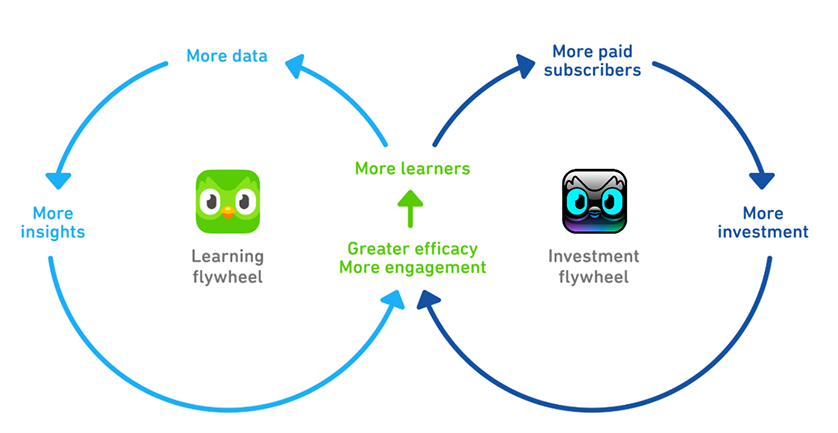
We have always bet on technology.From day one, we’ve believed technology will keep improving. That’s why we take a tech-first approach, even when current tools aren’t perfect. We invested in early text-to-speech despite its robotic sound, knowing it would soon enable high-quality audio at scale. We’ve also made major AI investments to accelerate learning. In Q1 2026 alone, we published 20,500 skills across our language courses, up from 7,100 per quarter in 2025 and 1,800 per quarter in 2024. Without these technology investments, this would have taken millions of dollars and more than a decade. We are applying the same AI and automation tools to efficiently build out our content in the Math course. AI also powers Video Call, allowing real-time conversation practice with our character Lily—something once only possible with a human tutor.
We prioritize building an excellent product. The only sustainable way to attract, retain, teach, and monetize users is by making our product better over time. Spammy notifications, deceptive patterns, and heavy paid acquisition are short-term tactics. Instead, we focus on long-term engagement— and since motivation is the hardest part of learning, we design Duolingo to be something users want to return to daily. We obsess over product quality, running 1,000+ A/B tests per quarter and refining every detail to make sure the experience is useful, intuitive, and delightful.
Our Strategy Pillars
At Duolingo, we have five evergreen Strategy Pillars. These are goals that we’re always working toward in service of our mission and business, with specific numbers and initiatives changing year on year. We also organize our company around these pillars, grouping teams that work on these shared objectives together.
While all five pillars remain central to our long-term vision, we are currently prioritizing growing users and teaching better. This means reducing friction in the free experience, investing in word of mouth, and expanding learning through AI-driven features and new subjects, all of which we believe will drive compounding growth and strengthen the foundation for long-term monetization.
1. Grow users. Despite 10x growth in DAUs since 2019, we’re just getting started. Nearly 2 billion people are estimated to be learning a language globally and with 52.7M DAUs, we’ve only scratched the surface. English learners—80% of language learners worldwide—make up just 46% of our DAUs, presenting huge potential. We’re also expanding the market: in a 2021 IPO survey, nearly 80% of U.S. Duolingo users weren’t actively learning a language before joining. Our growth investment is product-first, with nearly 90 PMs, engineers, and designers dedicated to it. Marketing accelerates, but doesn’t replace, this work—we keep budgets lean, focusing on organic brand-building and highly efficient performance marketing.
2. Teach better. We’re constantly pushing the boundaries of technology in education. Our Duolingo Method applies learning science to our products, and our efficacy research team ensures we’re always improving. When we find gaps, we build new features—like DuoRadio, which strengthens listening skills as a foundation for speaking. AI is also helping us expand our course offerings. In 2026, we reached a major milestone: nine of our most popular language courses now extend to B2, where learners are considered independent users and can unlock real-world opportunities like applying for jobs or attending university. Learners studying English, Spanish, French, German, Italian, Portuguese, Japanese, Korean, or Chinese can now progress to this level. Previously, most were limited to beginner content up to A2 (Duolingo Score 60).

3. Grow subscribers. To build a sustainable business, we must make subscriptions more valuable. Since our 2021 IPO, subscriber penetration has grown from 5% to 9.2% as of Q4 2025, though we remain underpenetrated compared to freemium tech peers. We offer two tiers: Super Duolingo, which removes ads and provides unlimited hearts, and Duolingo Max, which includes AI-powered features like Video Call, Explain My Answer, and Roleplay. To convert free users, we focus on improving subscription features while optimizing purchase flows, packaging, and pricing. Just as we see DAU growth potential with English learners, we believe millions of international subscribers remain untapped.
In 2026, we are focused on developing monetization approaches that support long-term growth, ensuring our free product remains a compelling experience for the broadest possible audience.

*Figures as of Q4 2025
4. Become the proficiency standard. There’s no universal way to describe language proficiency, and we want to fill that gap. Our vision is for learners to use a Duolingo Score (“I’m a Duolingo French 70” instead of “I’m intermediate”). We recently introduced this score in-app, ranging from 0 (beginner) to 129 (job-ready fluency). In parallel, we spent the past decade developing the Duolingo English Test (DET)—the world’s first web-only English proficiency exam that doesn’t require test takers to travel to a test center. By the end of 2025, the DET was accepted by 6,100+ institutions, including 98 of the top 100 U.S. universities.

5. Expand beyond language learning. We’ve never wanted to stop at language learning, and we believe there’s huge potential to expand our impact across education. In 2023, we launched Math and Music in the Duolingo app, both universally appealing subjects that, like languages, take years to master. And in 2025, we launched the Chess course. Our engaging, effective teaching method is a natural fit for them. As we grow these new subjects, we’re applying lessons from our language-learning success (and failures) to reach product-market fit faster.
And How We Don’t Do Strategy
We don’t have a detailed 3- or 5-year roadmap. Since our founding in 2011, we’ve learned that no plan or roadmap beats rapid testing, learning, and iteration. We call this approach “The Green Machine”: bring together great people, give them room to experiment, and double down on what works. To see how we operate, check out the Duolingo Handbook.
Our Beliefs and Strategy Pillars guide The Green Machine, but it’s our incredible talent that drives us forward. Building the best educational product depends on attracting and retaining top people, and we take a long-term view on hiring. We expect our team to grow with Duolingo—and it shows: with 90%+ annual retention, we stand out in our industry.
Fueling the Future
Duolingo’s mission wasn’t designed to be solved overnight. Instead, developing the best education in the world and making it universally available will fuel Duolingo far into the future, with untold market opportunity along the way. We’re purposely building a company and product that will outlast us, bringing education and enjoyment to new generations of people looking to learn. Backed by Duolingo’s mission, beliefs, and strategy, we’re confident in where we’re headed and excited for what’s next.